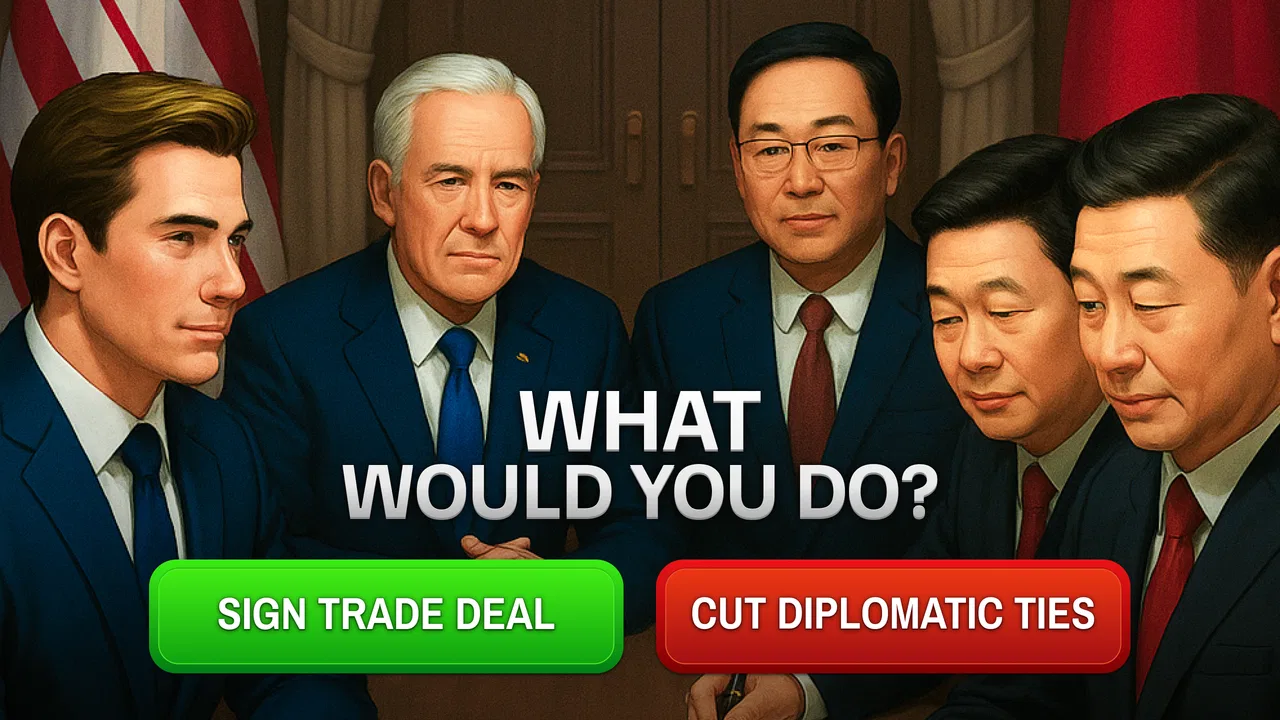
President: Simulator Game
- 3.6
- Rating
- 500.00K
- Installs
- Free
- Price

 Analysis by App-foxy
I spent time with President: Simulator Game as a political role-playing game, and my first impression was that it works best when treated as a decision-making challenge rather than a traditional character adventure. You are placed in the position of a national leader, where the central appeal comes from choosing how power should be used. The broad tension between democratic leadership and dictatorship gives the game an immediately understandable premise, but the interesting part is how those choices feel when you are trying to keep a country moving in a direction you can defend.
That makes it a particularly interesting option for a shared household device. One person can make a choice and hand the device to someone else, then compare how differently each player approaches the same political situation. I found that this kind of turn-taking creates more conversation than simply watching somebody play a conventional action game. At the same time, it is important to remember that this is a Teen-rated game, so I would not treat it as a suitable pick for very young children just because the controls are easy to understand.
How the political role-playing works in everyday play
The strongest reason to try this game is its premise. Many role-playing games ask me to improve a hero, collect equipment, or defeat enemies. Here, the role is more abstract and more argumentative: I am deciding what kind of leader I want to be. The choice between democracy and dictatorship is not just a decorative theme. It gives every session a clear direction and makes me think about consequences, authority, and the difference between short-term control and long-term legitimacy.
You May Also Like

 Blood Strike: 2.5 Anniversary
Blood Strike’s Loadouts Turn Every Drop Into a Tactical Gamble
A close look at Blood Strike’s custom loadouts: how fast access to signature weapons reshapes its battle royale rhythm, rewards preparation, and narrows the gap between fights.

 Pandora - Music & Podcasts
Pandora’s Music Is Easy to Start, but Harder to Recover
Pandora’s strength is its low-effort path from a seed to a station. Its weak spot is how much confidence it asks you to place in connection, setup, and quiet recovery.

 8 Ball Pool
 Is Built on Rivalries, Rematches, and Routine
A close look at the rivalries, rematches, shared routines, and unanswered safety questions that turn a quick pool match into a persistent mobile community.

 Samsung Music
’s Quiet Strength Is Playing What You Already Own
Its reach comes less from spectacle than from dependable access to a personal library. That simplicity is both the app’s strongest retention engine and its ceiling.

 AccuWeather: Weather Radar
AccuWeather Review: A Quick, Clear Forecast for Everyday Decisions
For everyday plans, the best forecast is the one you can understand quickly. AccuWeather makes rain timing, radar, and local conditions easy to act on, with a few trade-offs.

 Hill Climb Racing
Why Hill Climb Racing Still Turns Crashes Into One More Run
A tiny car, a bumpy hill and one more upgrade: Hill Climb Racing keeps resurfacing because its simple chaos makes every near-miss feel personal.
More From Our News Desk
View All News


I would describe the experience as a strategy conversation disguised as a game. It is not the right choice if you want fast reflex tests or a large action-focused world. It is better suited to players who enjoy weighing options, testing a political identity, and seeing whether a governing style can survive pressure. That distinction matters because the store summary may sound dramatic, while the actual appeal is quieter: the satisfaction comes from making a decision and living with the result.
On a normal evening, I can imagine one person playing for a few minutes, explaining why a particular decision was made, and then asking another household member what they would have done. That makes it more approachable than a complex political simulation that requires a long uninterrupted session. It also gives the game a useful social quality, even when only one person is holding the phone.
A practical shared-device scenario
Imagine two adults sharing a tablet after dinner. One player starts a leadership run with a preference for open, representative government. The other is more interested in testing strict control. Instead of arguing about politics in the abstract, both can use the game as a small experiment: what happens when the same national role is approached from opposite directions? I like this use because it turns the game into a prompt for discussion without requiring either person to agree with the other’s choices.
The best way to make that work is to keep each player’s decisions mentally separate. Do not assume that a single shared run represents both people’s style. One person may be exploring a hypothetical approach, while the other may be trying to win efficiently. If you pass the device around, say clearly whether the next player is continuing the same leadership experiment or beginning a separate one. That small boundary prevents confusion and makes later comparisons much more meaningful.
This is also where the game can be more useful than a passive political video. A video gives me somebody else’s conclusion. President: Simulator Game gives me a role and asks me to own the choice, even if I later decide that the choice was ineffective or uncomfortable. For a household that enjoys discussing current events, history, or leadership, that can be a worthwhile reason to install it.
Setting expectations before sharing it
Because the game deals with political power and includes a Teen content rating, I would establish expectations before putting it on a family device. A teenager may understand the fictional nature of the choices, while a younger child may focus on the simple idea of being “the president” without understanding the broader themes. The game can open a conversation about authority, but it should not be mistaken for a civics lesson or a substitute for adult guidance.
I also recommend agreeing on whether the device is being used for individual play or group experimentation. If several people use the same installation, the important boundary is not technical; it is conversational. Each person should know when they are making a decision for their own run and when they are affecting a shared session. That is especially useful if one player likes to test extreme choices while another prefers a cautious approach.
For a personal phone, this distinction is simpler. I can play privately and follow my own political path without explaining every decision. On a shared tablet, the game becomes more social, but it also becomes easier for one person to interrupt another’s plan. I found that the game’s value depends partly on respecting that difference.
Who should play and who should skip it
I think the game is a good match for people who enjoy political thought experiments, leadership dilemmas, and role-playing that is based more on policy direction than on combat. It may also appeal to players who normally avoid traditional role-playing games but like management or strategy titles. The clear premise makes it easy to understand, while the political framing gives the decisions more personality than a generic resource-management exercise.
I would skip it if you want a deep historical simulator with extensive factual context, or if you are looking for a multiplayer game built around direct competition. I would also look elsewhere if your main interest is a detailed story with a fixed protagonist and carefully scripted character relationships. This game’s identity is tied to the act of governing, not to a conventional adventure narrative.
It is less suitable for a household where political themes are likely to create friction rather than discussion. The democracy-versus-dictatorship framing is deliberately provocative. Some players will enjoy testing both sides as fictional strategies; others may find the subject too close to real-world disagreements. My advice is to consider the people using the device, not just the person who downloads the game.
What I noticed about progression, choices, and replay value
The main replay value comes from changing the leadership approach. I found myself asking whether a decision was being made because it fit my preferred ideology or because it seemed useful in the moment. That distinction gives the game more depth than simply selecting the option that sounds morally appealing. A player can begin with one intention and gradually discover that practical survival pushes the run in another direction.
A useful personal rule is to choose a governing principle before starting a session. For example, I might decide to prioritize public consent, or I might deliberately test how far centralized authority can go. Afterward, I can judge the run against that principle instead of only asking whether it “won.” This makes the game feel more like a role-playing exercise and less like a sequence of disconnected taps.
Another tip is to pause before selecting an option and explain the trade-off aloud, even when playing alone. I found that verbalizing the choice exposes whether I am following a coherent strategy or simply reacting to the latest problem. In a shared setting, this becomes a natural way to coordinate turns. One player can state the intended direction, while another can challenge the assumption without taking control of the run.
The game’s limitation is that political themes alone do not guarantee endless variety. If the available decisions begin to feel predictable, the novelty of the premise can wear off. That is why I would approach it in shorter sessions rather than expecting it to replace a large, long-form role-playing game. Its strongest moments come from interpretation and comparison, so playing continuously for hours may not deliver the same freshness as returning later with a different leadership idea.
How it compares with familiar alternatives
Compared with a conventional role-playing game, this title puts less emphasis on building a physical character and more on shaping a political identity. There is no need to think of it as a replacement for an adventure game; it serves a different purpose. I reach for it when I want to make consequential choices and reflect on leadership, not when I want exploration, combat, or a sprawling fantasy setting.
Compared with a detailed grand-strategy game, it is easier to explain to another person. A household member can understand the basic role almost immediately, which helps when sharing a device. The trade-off is that players who enjoy dense maps, elaborate economies, or highly granular historical systems may find this experience less demanding. I see it as a more accessible political role-playing option, not as a complete substitute for a full-scale strategy simulation.
Compared with a political quiz or interactive story, the game feels more game-like because I am not merely selecting answers to reveal a personality label. I am trying to lead, and that gives the choices a practical edge. Still, anyone expecting a textbook-style explanation of government should choose an educational app instead. The game encourages reflection through play, but its purpose is entertainment first.
Device sharing, accounts, and coordination
For shared use, I would keep expectations modest and organized. The game is installed on a device, but that does not automatically mean every player has a clearly separated identity. I would not rely on the app to preserve a perfect boundary between household members. Instead, use a simple routine: one person plays a session, announces when it ends, and the next person starts a clearly identified experiment or continues only with permission.
If several people are interested, a small written note can help. Record a player’s chosen leadership style and the point at which they stopped. This is not glamorous, but it avoids the common problem of opening a game later and forgetting which decisions belonged to whom. It also makes the device feel less like a contested object and more like a shared discussion tool.
Coordination matters even more when one player is younger. An adult can ask what the teenager thinks a decision represents, rather than simply praising a successful outcome. That approach keeps the focus on reasoning and helps separate fictional strategy from real-world endorsement. I would avoid presenting authoritarian choices as automatically clever or democratic choices as automatically easy; the most interesting conversations come from examining the cost of both.
Cost, age context, and purchasing awareness
The game is free to download, which makes trying it on a household device straightforward. It includes in-app purchases ranging from $4.99 to $39.99 per item, so I would discuss purchasing expectations before allowing unsupervised play on a shared phone or tablet. A free entry point is useful, but it should not be confused with a completely cost-free experience once optional purchases are considered.
That is particularly relevant when a teenager uses a parent’s device. The practical boundary is simple: decide in advance whether purchases are allowed, and who must approve them. I would not let the low initial cost create an assumption that every later transaction is harmless. The game’s political theme may attract curiosity, but the household decision about spending should remain separate from the excitement of a current run.
The Teen rating also changes how I would recommend it. For older teens and adults who can discuss political fiction thoughtfully, it can be an engaging shared experiment. For younger children, I would choose a gentler management or educational game. The issue is not only whether a child can operate the controls; it is whether the subject matter is appropriate for the conversation that may follow.
My household verdict after spending time with it
President: Simulator Game is an unusual role-playing choice because its central challenge is not becoming stronger in a fantasy world; it is deciding what kind of leader to become. Hidden Lake Games LLC has built the appeal around a premise that is easy to grasp but open to very different playing styles. With a 4.0 average from around ten thousand ratings and more than one hundred thousand installs, it has clearly attracted a meaningful audience, while the current version, 1.4.53, shows that the app is still being presented as an active product.
It is free, supports devices running Android 7.0 or later, and is easy to consider for a trial session. Those practical details make it accessible, but they do not remove the need to think about the age rating, shared-device boundaries, or optional spending. I would explain those points before handing it to a teenager, especially if the device belongs to more than one person.
My strongest recommendation is for households that enjoy discussing choices. Use it as a rotating leadership exercise: give each player a defined session, ask them to explain the principle behind their decisions, and compare the results without treating one political path as the universally correct answer. That workflow brings out more of the game’s value than silently rushing through options.
My main reservation is that players seeking a huge, deeply detailed strategy world may eventually want more complexity than this format provides. The game’s strength is its focused political premise and its ability to start a conversation quickly. Its weakness is that the same focus may feel narrow if you are looking for extensive exploration, competitive multiplayer, or a richly scripted campaign.
Overall, I would recommend it to adults and suitably mature teens who like role-playing through leadership decisions and want something that can work both privately and as a shared-device discussion. The best reason to install it is not simply to become president, but to test how your idea of good leadership behaves when the game asks you to act on it. For a household willing to set clear turn-taking, age, and purchase boundaries, that makes this a thoughtful and distinctive political game rather than just another free download.
FAQs for President: Simulator Game
01What is the main objective of President: Simulator Game?
In President: Simulator Game, your primary goal is to successfully manage a country as its leader. You'll make decisions on economic policies, diplomacy, military strategy, and social issues. Balancing these elements is crucial to maintaining public support and ensuring the prosperity and stability of your nation.
02How does the game handle decision-making and consequences?
The game features a dynamic decision-making system where each choice affects various aspects of your country. Decisions impact economic growth, international relations, and public opinion. Players must weigh the potential benefits and drawbacks, as poor decisions can lead to crises or political instability.
03Are there real-world countries and scenarios included in the game?
Yes, President: Simulator Game includes a wide range of real-world countries, each with unique challenges and scenarios. Players can choose to lead any country and experience different geopolitical dynamics, allowing for diverse gameplay and replayability as you navigate through historical and fictional events.
04Does the game require an internet connection to play?
President: Simulator Game can be played offline for the main single-player campaign. However, certain features, such as global leaderboards or updates, might require an internet connection. It's recommended to connect occasionally to access the latest content and improvements.
05Is President: Simulator Game suitable for all ages?
The game is generally suitable for teenagers and adults due to its strategic complexity and themes involving politics and economics. It may not be appropriate for younger children as it requires critical thinking and understanding of global issues. Parental guidance is advised for younger players.
Pros
- Realistic political scenarios
- Diverse decision-making options
- Engaging and educational
- Multiple endings possible
- Intuitive interface
Cons
- In-app purchases required
- Occasional bugs and glitches
- Limited character customization
- Repetitive tasks over time
- No multiplayer mode

President: Simulator Game
Gallery